
Calculus I Course Overview
Course Description
Calculus I introduces students to the mathematics of change and accumulation, providing the foundation for advanced study in science, engineering, technology, and economics.
In this course, students will explore how quantities change, how to model real-world systems, and how to analyze those systems using powerful mathematical tools. Beginning with limits and continuity, the course builds toward derivatives, applications of derivatives, and integrals—culminating in the Fundamental Theorem of Calculus.
What You Will Learn
By the end of this course, students will be able to:
Evaluate and interpret limits
Determine continuity and apply the Intermediate Value Theorem
Compute and interpret derivatives using multiple methods
Apply derivatives to real-world problems such as:
Optimization
Related rates
Linear approximation
Understand and compute antiderivatives
Evaluate definite integrals and interpret them as accumulation
Apply the Fundamental Theorem of Calculus
Use substitution to simplify and solve complex integrals
How You Will Learn
This course is designed to support deep understanding through multiple learning approaches:
Interactive Visualizations (Desmos activities)
Instructional Videos
Structured Practice Worksheets
Engagement Activities (Kahoot, Jeopardy-style games)
Collaborative Learning & Guided Support
Concept-Based Assessments
Students will not only learn how to perform calculations, but also how to interpret, explain, and apply calculus concepts.
Course Structure
The course is organized into the following major units:
Limits & Continuity
Derivatives & Rules
Applications of Derivatives
Antiderivatives
Definite Integrals
Fundamental Theorem of Calculus
Substitution (u-Substitution)
Each unit builds on the previous one, creating a cohesive understanding of calculus as a complete system.
Real-World Connections
Calculus is used to model and solve problems involving:
Motion and velocity
Growth and decay
Optimization of resources
Engineering and design
Economics and data analysis
Throughout the course, students will connect mathematical concepts to real-world scenarios and applications.
Who This Course Is For
This course is ideal for students who:
Are preparing for STEM majors or careers
Want to strengthen problem-solving and analytical thinking
Are interested in understanding how mathematics describes the world
Course Philosophy
This course emphasizes:
👉 Understanding over memorization
👉 Strategy over shortcuts
👉 Application over isolation
Students will develop the ability to not only solve problems, but also to explain their reasoning and apply their knowledge in new situations.
Final Outcome
By the end of this course, students will have built a complete understanding of:
👉How things change(derivatives)
👉How things accumulate(integrals)
👉How those ideas are connected(Fundamental Theorem of Calculus)
Course Videos
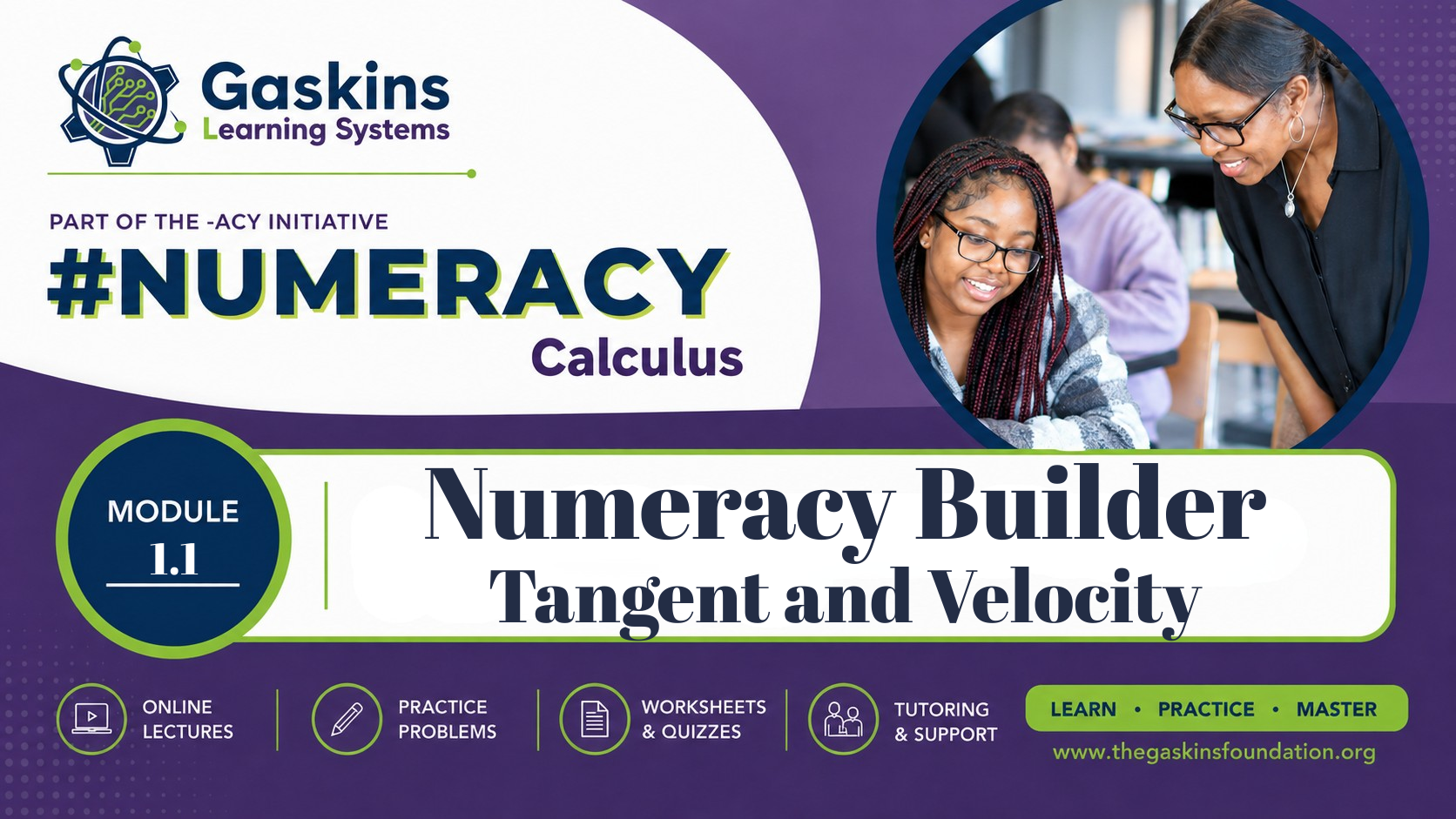
Welcome to Calculus 1

Learning Videos
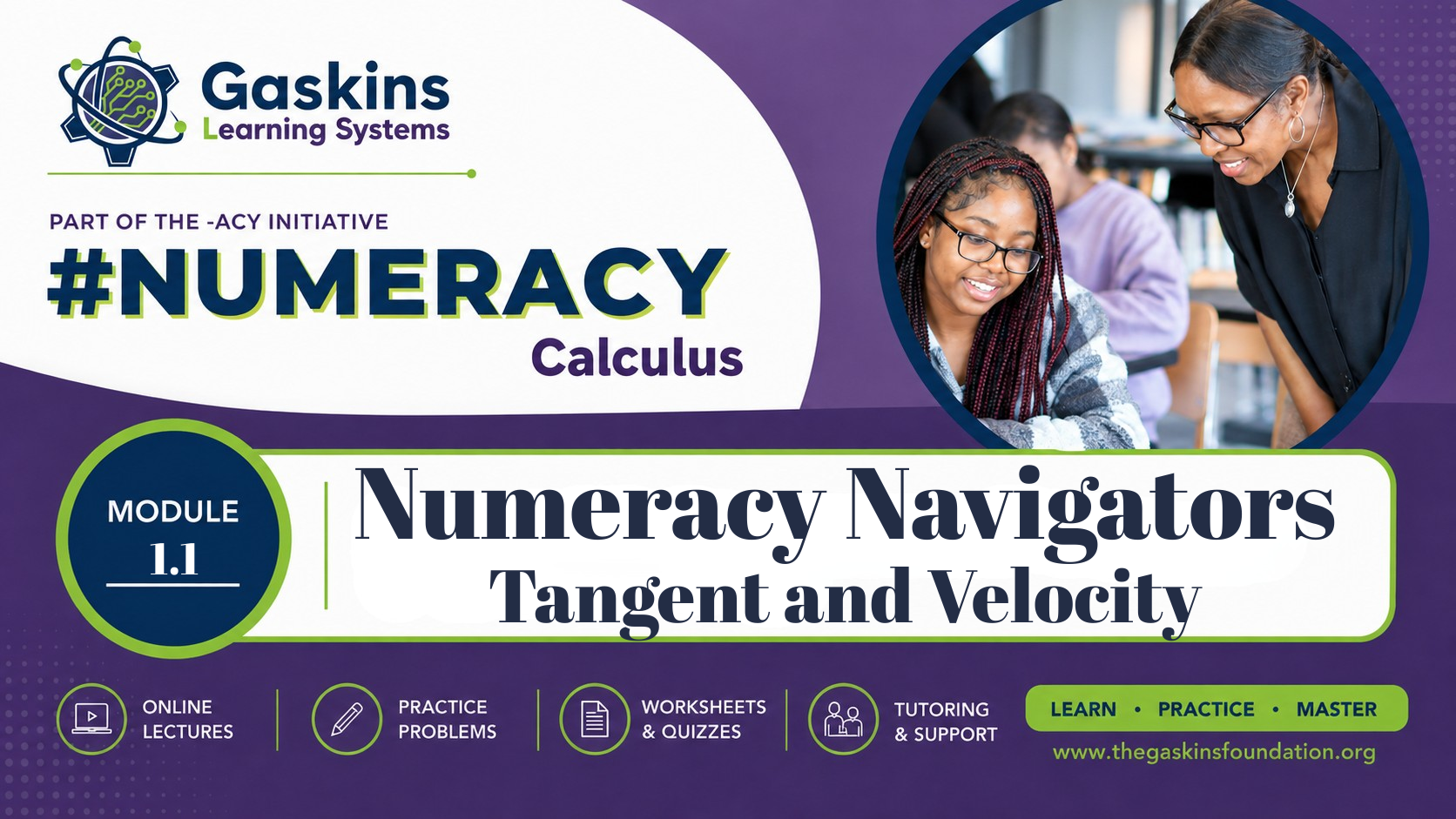
From Average to Instantaneous Change
Lesson Objectives
By the end of this lesson, students will be able to:
Interpret average rate of change using secant lines
Explain the difference between secant and tangent lines
Compute average velocity over an interval
Use limits to determine instantaneous velocity
Connect derivatives to real-world motion problems
Essential Question
How can we determine how fast something is moving at exactly one moment in time?

Learning Videos

Understanding Limits: Graphical, Numerical, and Algebraic Approaches
🎯 Lesson Objectives
By the end of this lesson, students will be able to:
Describe a limit as the value a function approaches
Evaluate limits using:
Graphs
Tables
Algebraic methods
Distinguish between left-hand and right-hand limits
Determine when a limit exists or does not exist
Explain limits in their own words using real-world context
🧠 Essential Question
What does it mean for a function to “approach” a value, and why does that matter?

Learning Videos
Continuity & the Intermediate Value Theorem: Understanding What Must Happen
🎯 Lesson Objectives
By the end of this lesson, students will be able to:
Define continuity using limits
Verify whether a function is continuous at a point
Identify types of discontinuities:
Removable
Jump
Infinite
Explain the three conditions of continuity
Apply the Intermediate Value Theorem (IVT)
Interpret IVT in both mathematical and real-world contexts
🧠 Essential Question
When a function is continuous, what are we guaranteed about its behavior?


Learning Videos
Definition of a Derivative: From Average Change to Instantaneous Change
🎯 Lesson Objectives
By the end of this lesson, students will be able to:
Define the derivative as a limit of the difference quotient
Interpret the derivative as:
Instantaneous rate of change
Slope of a tangent line
Compute derivatives using the limit definition
Distinguish between:
Average rate of change (secant line)
Instantaneous rate of change (tangent line)
Explain the derivative concept verbally, graphically, and algebraically
🧠 Essential Question
How can we measure how something is changing at an exact moment in time?


Learning Videos
Derivative Rules (Power, Product, Quotient, Chain): Efficiently Computing Rates of Change
Lesson Objectives
By the end of this lesson, students will be able to:
Apply the Power Rule to differentiate polynomial terms
Use the Product Rule for functions involving multiplication
Use the Quotient Rule for functions involving division
Apply the Chain Rule to composite functions
Identify the correct rule based on the structure of a function
Compute derivatives accurately and efficiently
Explain which rule was used and why
Essential Question
How can we quickly and correctly find derivatives by recognizing patterns in functions?


Learning Videos
Derivatives of Exponential, Logarithmic, and Trigonometric Functions
🎯 Lesson Objectives
By the end of this lesson, students will be able to:
Differentiate exponential functions:
e^x, a^x
Differentiate logarithmic functions:
ln x, ln(g(x))
Differentiate trigonometric functions:
sin x, cos x, tan x
Apply the chain rule to all function types
Identify the structure of a function and select the correct method
Interpret derivatives in real-world contexts (growth, decay, waves)
🧠 Essential Question
How do different types of functions change, and how can we measure that change efficiently?

Learning Videos
Implicit Differentiation: Finding Derivatives Without Solving for y
Lesson Objectives
By the end of this lesson, students will be able to:
Differentiate equations where y is not isolated
Apply the chain rule to y-terms
Use the product rule when x and y are multiplied
Solve for dy/dx after differentiating
Interpret dy/dx as the slope of a tangent line
Explain why implicit differentiation works conceptually
Essential Question
How can we find the rate of change when a function is not explicitly solved for y?